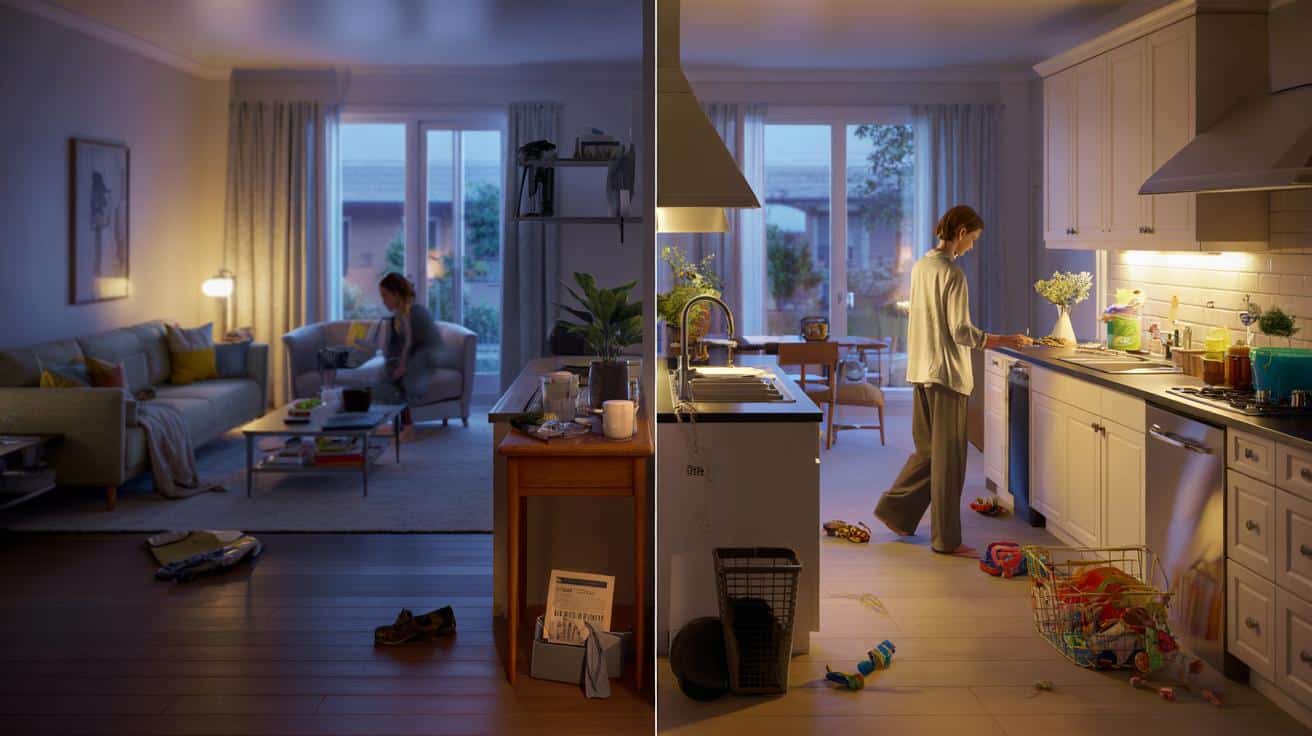
Friday night, 9:47 p.m.
You drop your bag, kick off your shoes, and suddenly *see* your home.
The dishes balancing in the sink, laundry slumped like a tired guest on the chair, crumbs staging a coup on the counter.
You had big plans for the weekend – brunch, a long walk, maybe a nap – but the state of the living room answers for you.
The weekend has already been booked, and the appointment is called “deep clean”.
Somewhere between Monday’s rushed coffee and Thursday’s late emails, the mess quietly won.
And the worst part? You knew this feeling was coming by Wednesday.
Why tiny daily resets change the whole weekend story
There’s a strange thing that happens when you start doing tiny five-minute resets during the week.
The mess doesn’t disappear – life is still life – but it stops growing into a monster.
A wiped counter here, a quick laundry sort there, a 10-minute tidy before bed, and suddenly Saturday morning doesn’t feel like a punishment.
You wake up and your home looks… fine.
Not Instagram-perfect, not ready for a magazine shoot, just quietly under control.
That low-level background stress, the one that hums every time you walk past a pile, turns down a notch.
Your weekend starts with choice, not chores.
Take the classic “Sunday cleaning marathon” script.
Maybe this sounds familiar: you avoid most housework during the week because you’re exhausted, then block out Sunday “to get on top of everything”.
By the time you’ve stripped the beds, scrubbed the bathroom, tackled the kitchen, and argued about who’s doing what, half the day has vanished.
By late afternoon, you’re cranky, your back is sore, and the looming Monday feels closer than it should.
That mythical “restful weekend” evaporates into a pile of folded towels.
You might get a clean house, but it’s bought at the cost of your only real downtime.
That’s the trade no one talks about out loud.
The logic behind daily resets is almost boring in its simplicity.
Our homes aren’t getting “messy all at once”; they’re getting “2% messier, 50 times a day”.
When you only respond once a week, you’re battling the accumulated weight of dozens of tiny undone moments.
Short, consistent resets interrupt that accumulation.
You’re not cleaning more, you’re just cleaning differently – shrinking the size of each task until it feels almost too small to matter.
The big psychological shift? A 7-minute kitchen reset after dinner feels doable on a Tuesday night.
A three-hour kitchen marathon on Saturday feels like a sentence.
What a daily reset really looks like (and what it doesn’t)
A “daily reset” sounds fancy, but in real homes it usually looks like a series of small, boring moves.
Clearing the living-room surfaces before bed.
Starting the dishwasher even if it’s not at 120% capacity.
Folding the clothes from the dryer instead of letting them live there for three days.
Think of it as bringing each room back to “functional neutral” once a day.
Not spotless, not perfect, just ready for the next round of life.
A reset might be: putting toys back in the basket, tossing mail into a single tray, wiping the bathroom sink after brushing your teeth.
Ten minutes, low effort, big ripple.
➡️ Why this haircut suits busy lifestyles more than trendy styles
➡️ “I felt financial pressure even when nothing was ‘wrong’”
➡️ People who feel pressure to adapt constantly often suppress emotional feedback
➡️ If you feel weighed down by minor choices, psychology explains the hidden emotional load
➡️ Feeling emotionally “on standby” is a learned psychological response
➡️ A small change in how you organize bags can save time every morning
➡️ I tried this creamy tuna pasta bake and it brought back childhood memories
➡️ If you’re over 65, this subtle shift in appetite is more physiological than emotional
The trap many of us fall into is turning daily resets into yet another impossible standard.
We read a blog post, make a 27-point checklist, and last exactly two days.
Then life throws a curveball – late meeting, sick kid, terrible sleep – and the routine breaks, so we quietly abandon it.
Let’s be honest: nobody really does this every single day.
The point isn’t perfection, it’s direction.
Missing a night doesn’t cancel the entire system; it just means tomorrow’s reset might be 15 minutes instead of 7.
Forgiving the gaps is the only way this becomes a habit instead of a guilt machine.
“Daily resets saved my weekends,” a reader named Maya told me.
“I stopped aiming for a ‘clean house’ and started aiming for a ‘reset house’ – just ready for tomorrow, not ready for Pinterest.”
Her version is stripped-back and honest.
Bedroom: clothes in hamper, nightstand cleared, curtains opened in the morning, closed at night.
Kitchen: counters wiped, dishes done or at least corralled, trash taken out before it overflows.
- 5–10 minute evening reset in the two rooms you use most
- One “anchor habit” (like always starting the dishwasher before bed)
- One tiny morning move: open blinds, smooth the bed, clear one surface
- One weekly “deeper” task folded into a weekday (bathroom, sheets, fridge)
*Small, repeatable, slightly imperfect – that’s the formula that actually survives real life.*
The quiet freedom of a weekend that isn’t held hostage by housework
Something subtle happens when your weekend isn’t swallowed by a cleaning marathon.
You don’t just gain time, you gain a different quality of time.
Breakfast can drift into a second cup of coffee without the guilty glance at the grimy stove.
Spontaneous plans stop feeling like reckless decisions.
Daily resets won’t remove every mess; life stays beautifully chaotic.
What they do is stop the mess from running your schedule in the background.
You start the weekend at “maintained” instead of “disaster recovery mode”, and that changes what you’re willing to say yes to.
You might not even notice it at first, you just feel… lighter.
| Key point | Detail | Value for the reader |
|---|---|---|
| Daily resets are tiny and specific | Short bursts of 5–15 minutes focused on “functional neutral” rooms | Feels doable on weekdays, even when energy is low |
| Consistency beats perfection | Missing a day is expected, the habit survives through flexible routines | Reduces guilt and all-or-nothing thinking around housework |
| Weekends shift from recovery to choice | Less accumulated mess means fewer hours of deep cleaning | More space for rest, hobbies, and social life |
FAQ:
- How long should a daily reset take?Most people land somewhere between 10 and 25 minutes total, split across one or two short bursts. If your reset takes more than 30 minutes most days, you’re probably trying to do deep cleaning instead of light maintenance.
- When is the best time to do it?The most realistic slot is usually right after dinner or just before getting ready for bed. Some people prefer a tiny morning reset as well – two minutes to smooth the bed, open blinds, and clear one surface.
- What if I live with messy people?Start with your own “zones” first: your bedside, your desk, one corner of the living room. Then add a super-simple family rule or two, like “10-minute tidy before screen time” or “dishes to the sink after eating”. Small, shared habits beat big, nagging speeches.
- Can daily resets replace deep cleaning completely?No, you’ll still need occasional deeper tasks like scrubbing grout or cleaning the oven. The difference is that these become planned, lighter jobs rather than emergency responses to chaos. Resets keep the baseline under control.
- How do I start if my home is already a disaster?Pick one room or even one surface and do a “reset-lite” there for a week. Ignore the rest on purpose. Once that spot feels manageable, expand slowly. Trying to fix the whole house in one go is exactly what creates those dreaded weekend marathons.