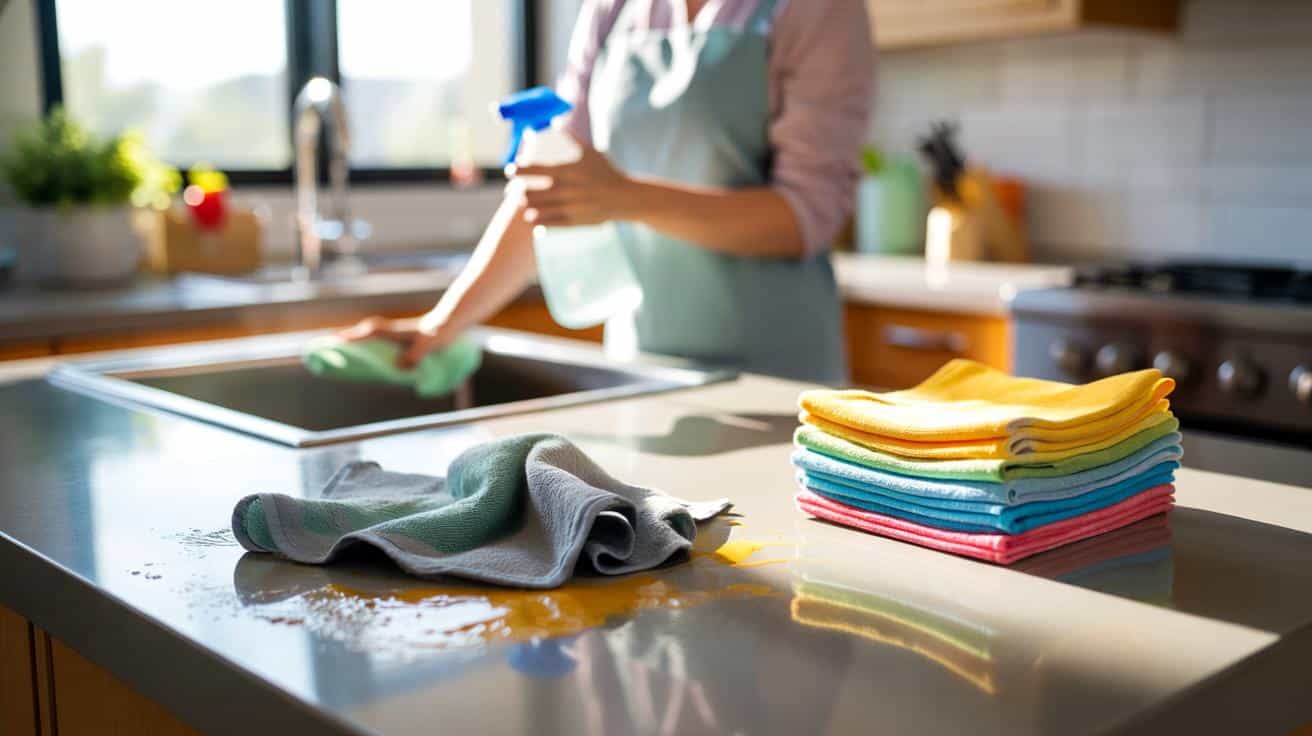
It usually starts on a Sunday afternoon. The vacuum is out, there’s a podcast playing in the background, and you’re in that strangely satisfying mood where cleaning almost feels therapeutic. You wipe the counter, spray something that smells like fake lemons, swipe again for good measure. For a brief moment, the kitchen shines and you feel like you’ve got life together.
Then Monday morning arrives. The light hits differently, and you notice the cloudy streaks on the stainless steel, the sticky edge of the counter you apparently “cleaned”, the crumbs that somehow migrated under the toaster. You sigh, grab the spray again, and the loop begins.
There’s a tiny, common cleaning habit hiding in this scene that quietly doubles your work.
And most people don’t even realize they’re doing it.
The habit that feels clean… but quietly backfires
Most of us clean in fast-forward. We grab an all-purpose spray, mist every surface in sight, and wipe everything down with the same cloth until it’s damp, grey and vaguely disgusting. It feels efficient, almost professional. One quick pass, and the visual chaos disappears.
The problem is what we don’t see. That one cloth is silently spreading grease from the stove to the fridge handle, crumbs from the table to the high chair, bathroom bacteria to… well, anywhere. The surface looks clean at a glance, so our brain ticks “done”, but the mess isn’t really gone. It’s just been smeared into a thin, invisible layer.
Picture this. You cook a pasta dinner, there’s sauce splatter near the hob, a ring of oil around the pan, a drip of something unidentifiable near the sink. You wipe it all with your “kitchen cloth”. Later, a child snacks at the counter, resting a piece of bread exactly where you passed that cloth. No obvious stain, no sticky mark, nothing dramatic.
By midweek, crumbs cling to that slightly greasy film, dust fuses with it, and suddenly the counter feels permanently grimy. So you clean again. Harder this time. Maybe a stronger product. You’ve just multiplied the workload created by that first enthusiastic, but lazy, swipe.
Here’s the logic behind this little trap. Our brain loves shortcuts. One cloth, one spray, one round through the house sounds like smart multitasking. It’s the same instinct that makes us stack six things in our arms instead of taking two easy trips. But cleaning is chemistry and friction, not just appearances. When the cloth is too wet, too dirty, or used on too many different areas, it stops picking up and starts spreading.
*You think you’re deleting dirt, when you’re really just dragging a very thin layer of it to the next spot.* Over a week, that means more build-up, more scrubbing, and more “how is this already dirty again?” frustration.
The tiny shift that actually reduces your cleaning time
The habit that flips the script is almost embarrassingly basic: separate, then swap. Separate by zone, swap more often than feels “necessary”. One cloth for the kitchen counter and table. Another for the stove and greasy areas. A different one for the bathroom. Then, mid-clean, you swap a cloth the moment it feels even slightly damp and used.
➡️ If you feel mentally crowded, psychology explains how emotional load accumulates
➡️ Feeling emotionally “on standby” is a learned psychological response
➡️ This job allows workers to earn comfortably without relocating
➡️ “I didn’t know why evenings disappeared,” this routine fixed it
➡️ “I felt financial pressure even when nothing was ‘wrong’”
➡️ If you feel weighed down by minor choices, psychology explains the hidden emotional load
➡️ If you feel uneasy when plans change suddenly, psychology explains the need for internal order
➡️ “After 60, my sleep improved when I dimmed lights”: the melatonin sensitivity shift
Yes, it feels slower at first. Yes, it feels a bit fussy. But this is how you actually remove dirt instead of escorting it around your home. The surfaces stay cleaner for longer, dust and grease have nothing to cling to, and you stop re-cleaning the same areas every 48 hours.
Here’s a simple method many professional cleaners live by, even if they don’t always say it out loud. Start with a small pile of clean microfiber cloths in two colors. Light color for “low risk” areas like living room surfaces and bedroom furniture. Dark color for kitchen grease or bathroom zones. Once a cloth has done one role, it’s out. Straight to the laundry basket, no second career on the fridge door.
Let’s be honest: nobody really does this every single day. Life is messy, and sometimes we do grab the nearest thing. But if you shift this habit even 60% of the time, you’ll feel the difference. Less sticky dust, fewer mystery streaks, and far fewer “ugh, I just cleaned this” moments.
“Once I stopped using the same cloth for my whole apartment, I noticed I was cleaning less, not more,” says Léa, 32, who works remotely from a small city flat. “My counters didn’t have that permanent film, my bathroom didn’t smell like old mop water, and I wasn’t constantly wiping the same spots. I thought it would be a chore. It actually felt like a relief.”
- Use color codes for cloths so you don’t have to think every time.
- Keep a small basket of clean cloths in the main cleaning area, not buried in a closet.
- Stop the cloth the moment it looks tired, not when you’ve “finished the room”.
- Wash at high temperature so the cloth itself doesn’t become the problem.
- Reserve one “good” cloth for glass and mirrors only, so you don’t chase streaks later.
Changing the story you tell yourself about cleaning
There’s something deeper hiding behind this small cloth habit. Many of us clean like we’re chasing the feeling of order more than the reality of hygiene. We want the quick visual hit: the shiny counter, the cleared table, the bed made in five seconds. One cloth, one tour of the home, and the day feels lighter.
Yet that shortcut steals time from our future self. The more we smear dirt instead of lifting it, the more we lock ourselves into a cycle of constant light cleaning that never truly satisfies. We’re always “almost” on top of it, never really done. That’s exhausting in a quiet, everyday way.
| Key point | Detail | Value for the reader |
|---|---|---|
| Separate cloths by zone | Use different cloths for kitchen, bathroom, and living areas | Less cross-contamination, surfaces stay cleaner longer |
| Swap cloths more often | Change as soon as they’re visibly damp or dirty | Removes dirt instead of spreading it, reduces deep-clean sessions |
| Prepare a simple system | Color codes, small cloth stash, clear laundry routine | Makes “real” cleaning almost automatic and less stressful |
FAQ:
- Question 1Can I still use one multi-surface spray if I change cloths?
- Answer 1Yes, the product can be the same. The key is what carries the dirt away. Fresh cloths with the same spray will still cut your workload because you’re not dragging yesterday’s grime across today’s surfaces.
- Question 2How many cloths do I realistically need?
- Answer 2For a small home, a set of 8–10 microfiber cloths is usually enough: a few for the kitchen, a couple for the bathroom, and some for “clean” areas like bedrooms and living room.
- Question 3Is it really worth splitting bathroom and kitchen cloths?
- Answer 3Yes. Kitchen grease and bathroom bacteria are very different “dirt families”. Mixing them on one cloth just creates a sticky, smelly mess that forces you to re-clean both zones more often.
- Question 4What’s the best way to wash cleaning cloths?
- Answer 4Wash them hot, skip fabric softener, and let them dry completely between uses. Softener can coat fibers and reduce their ability to grab dirt, which means more wiping for you later.
- Question 5What if I don’t have time for a perfect system?
- Answer 5Start with one tiny rule: never use the same cloth for bathroom and kitchen. Even that single boundary cuts a lot of hidden rework and makes your weekly clean much easier.