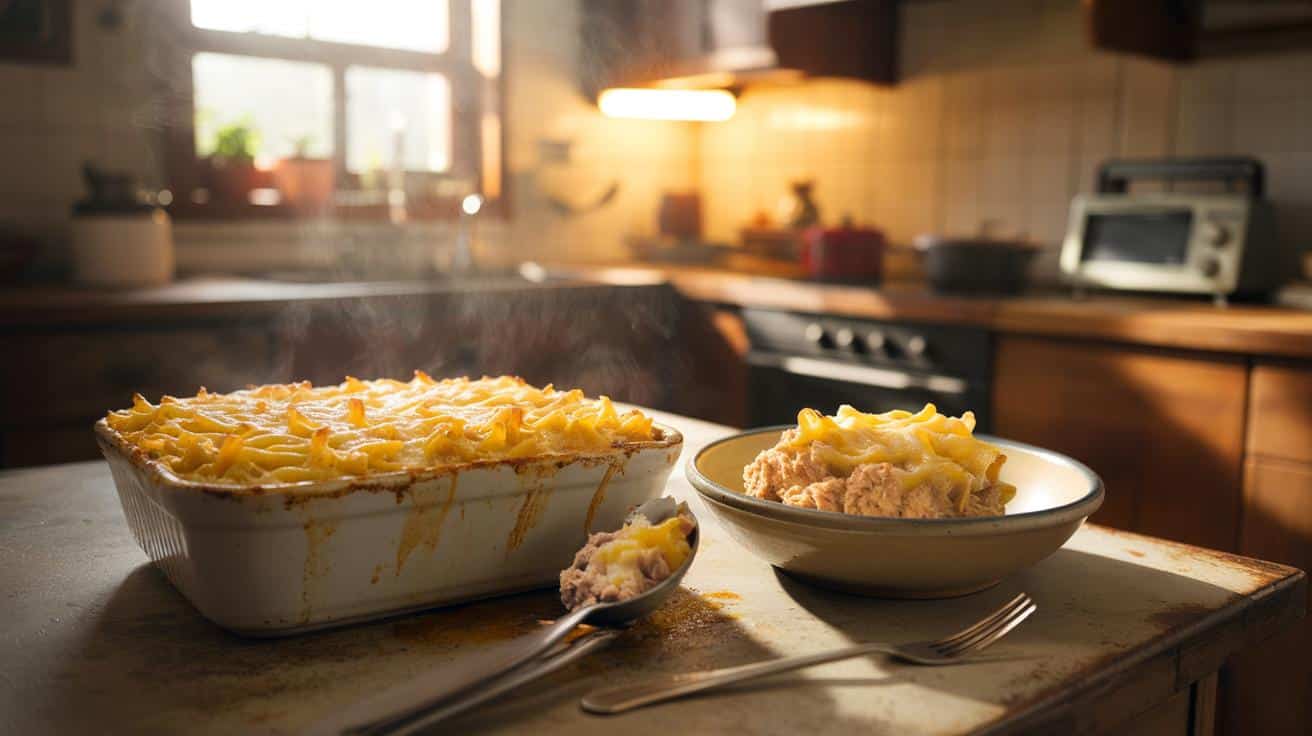
The smell hit me before the oven timer did. That warm, familiar mix of baked cheese, tuna, and something creamy I couldn’t quite name dragged me straight back to a tiny kitchen with orange tiles and a radio humming in the corner. For a second, I wasn’t scrolling recipes on my phone. I was eight years old again, swinging my legs under the table, waiting impatiently for my mum to say, “Careful, it’s hot.”
I’d thrown the dish together on a random Tuesday, half out of hunger, half out of nostalgia. A creamy tuna pasta bake: the kind of meal that sounds almost too simple for the amount of comfort it brings.
When I pulled it from the oven and heard that gentle crackle of cheese cooling, I realised something quietly powerful.
Food remembers us, even when we’ve forgotten parts of ourselves.
Creamy tuna pasta bake: why this “basic” dish hits so deep
The first forkful was like opening a door I didn’t know was still locked. Soft pasta, those salty chunks of tuna, the rich sauce clinging to every curve of the spirals. Suddenly I was back at my childhood table, listening to cutlery clink and my parents chat about nothing in particular.
There’s something almost disarming about a dish that doesn’t pretend to be fancy. No rare ingredients. No dramatic presentation. Just an oven-proof dish, a bubbling top, a bit of golden cheese.
That first bite tasted like school nights, homework half done, and the comfort of knowing dinner would always, somehow, appear.
A lot of us grew up with some version of this casserole. Maybe your family used penne, maybe elbow macaroni. Some people swear by peas mixed in, others add sweetcorn, others toss in whatever was left in the fridge. The recipe shifts from house to house, but the feeling is strangely consistent.
I posted a quick photo of my pasta bake on social media, nothing styled, just steam and cheese. Within minutes friends were messaging: “My mum used to make this!” “Omg this is my childhood in a dish.” “Haven’t had this in years, I need to try again.”
One simple tray of pasta turned into a thread of memories: after-school dinners, rainy Sundays, grandparents who didn’t use recipes, just “a bit of this, a bit of that.”
There’s a reason this kind of recipe hits harder than a perfect restaurant plate. Our brains quietly link taste to time, smell to people, textures to places. Creamy tuna pasta bake isn’t just carbs and dairy. It’s the feeling of being looked after when life was smaller and the biggest drama of the day was losing a sock.
➡️ If you feel uneasy when plans change suddenly, psychology explains the need for internal order
➡️ Psychology shows why emotional regulation is shaped over time, not instinct
➡️ “After 60, my sleep improved when I dimmed lights”: the melatonin sensitivity shift
➡️ If you’re over 65, this subtle shift in appetite is more physiological than emotional
➡️ This job allows workers to earn comfortably without relocating
➡️ “I didn’t know why evenings disappeared,” this routine fixed it
➡️ Why this haircut suits busy lifestyles more than trendy styles
➡️ This common cleaning habit actually creates more work later
When we’re tired of “meal prep hacks” and 20-step gourmet dishes, something inside us craves that uncomplicated warmth. A dish you can assemble with cheap pantry staples and a bit of patience.
Let’s be honest: nobody really cooks like a TV chef every single day.
Sometimes you just want to scoop out comfort with a big spoon and eat it straight from the dish.
How to recreate that nostalgic pasta bake (without overcomplicating it)
My version started like most weeknight miracles: with whatever I already had. A bag of short pasta. Two cans of tuna in brine. A brick of cheese. Some milk. Butter. Flour.
First, I boiled the pasta until just shy of done, because it would keep cooking in the oven. In another pan, I made a simple white sauce: melt butter, whisk in flour, slowly add milk until it thickens. Nothing fancy, no special tools, just a whisk and a bit of attention.
Then came the quiet magic: stirring in the tuna, a handful of grated cheese, a small spoon of mustard, salt, pepper. The sauce turned rich and silky, clinging to the pasta like it had been waiting for this reunion all along.
If you’re tempted to go full gourmet, that’s your call, but the charm of this dish lives in its humility. Use the pasta you like. Use the cheese you have. Cheddar is classic, but any melty cheese will basically hug the top into a golden crust.
One thing people often regret is drying it out. That happens when there’s not quite enough sauce, or when the bake stays too long in the oven. The trick is to keep the mixture slightly looser than you think you need before baking. The pasta drinks some of that creaminess as it finishes cooking in the heat.
And if your first attempt isn’t “Instagram perfect”? That’s fine. Comfort food doesn’t need a filter to do its job.
I ended up texting my mum to ask how she “really” used to do it. She laughed down the line and admitted she never followed a strict recipe.
“I’d just check the cupboard, boil the pasta, open a can of tuna, then guess the rest until it looked right,” she said. “You kids never complained, anyway.”
Her “method” could be summed up in a loose little checklist:
- Cook short pasta until almost done, then drain.
- Prepare a white sauce with butter, flour, and milk.
- Stir in canned tuna, grated cheese, and seasoning.
- Combine sauce and pasta, pour into a baking dish.
- Top with more cheese (and breadcrumbs if you like), then bake until bubbling.
*That’s it: no measuring cups lined up like soldiers on the counter, just a feel for when comfort looks ready.*
When a simple tray of pasta connects past and present
Sitting there with my bowl of creamy tuna pasta, I realised this wasn’t just food. It was a bridge. Between the rushed adult life where dinner is another item on a to-do list, and the slower evenings when someone else did the cooking and we simply showed up.
A dish like this invites you to pause. Not for a fancy occasion, not for guests, just for yourself. To feel the weight of a warm bowl in your hands and think, quietly, “I deserve this softness today.”
Maybe you have your own version tucked away in your memory: a lasagna your aunt used to make, a simple soup your dad threw together, a rice dish that only appeared on cold nights.
What happens if you bring it back, even roughly, even imperfectly? The recipe doesn’t have to be exact for the feeling to land. You might swap ingredients, lighten the sauce, add veggies, change the cheese. The point isn’t to recreate the past with scientific precision.
It’s to honour that younger version of you who once sat at a table and felt safe enough to eat without overthinking it. That’s the quiet gift of these “ordinary” meals. They remind us that nourishment isn’t just about nutrients, it’s about stories and seasons and faces around a table.
Food like this doesn’t ask you to perform. It just asks you to arrive, fork in hand.
Next time you’re staring at the cupboard, tired and tempted to order something anonymous, you might try this instead. Boil the pasta. Open the tuna. Stir together a sauce that doesn’t have to be perfect, only warm.
Let the smell fill your kitchen, even if your kitchen is a studio with a tiny oven and one mismatched baking dish. Then pay attention to what surfaces in your mind as the cheese turns golden. A voice. A song on the radio. A chair you used to sit in.
You might discover that your favourite childhood cookbook wasn’t on a shelf at all.
It was written, quietly, in the meals people made for you when you were too young to notice.
| Key point | Detail | Value for the reader |
|---|---|---|
| Simple ingredients | Pasta, canned tuna, basic white sauce, grated cheese | Makes the dish affordable, accessible, and easy to recreate on busy days |
| Nostalgic power | Smell and taste trigger vivid childhood memories | Helps reconnect with comforting moments and family traditions |
| Flexible recipe | Can adapt pasta shapes, cheeses, and add-ins like peas or sweetcorn | Allows readers to personalise the bake while keeping its cosy spirit |
FAQ:
- Can I use a different protein instead of tuna?Yes, you can swap tuna for shredded chicken, leftover roast meat, or even cooked lentils for a vegetarian version, though the flavour will shift slightly from the classic “tuna bake” memory.
- How do I stop my pasta bake from drying out?Keep the sauce a bit runnier than you think you need, cover with foil for part of the baking time, and avoid leaving it too long in the oven.
- Can I prepare it in advance?You can assemble the dish, cover it, and refrigerate for a few hours, then bake when ready, adding a splash of milk or cream if it seems too thick.
- Is it freezer-friendly?Yes, you can freeze portions once baked and cooled; reheat gently with a little extra liquid and fresh cheese on top to revive the creaminess.
- What cheese works best for the topping?Cheddar, mozzarella, or a simple mix of whatever melty cheese you have on hand will give that satisfying golden, bubbling finish.