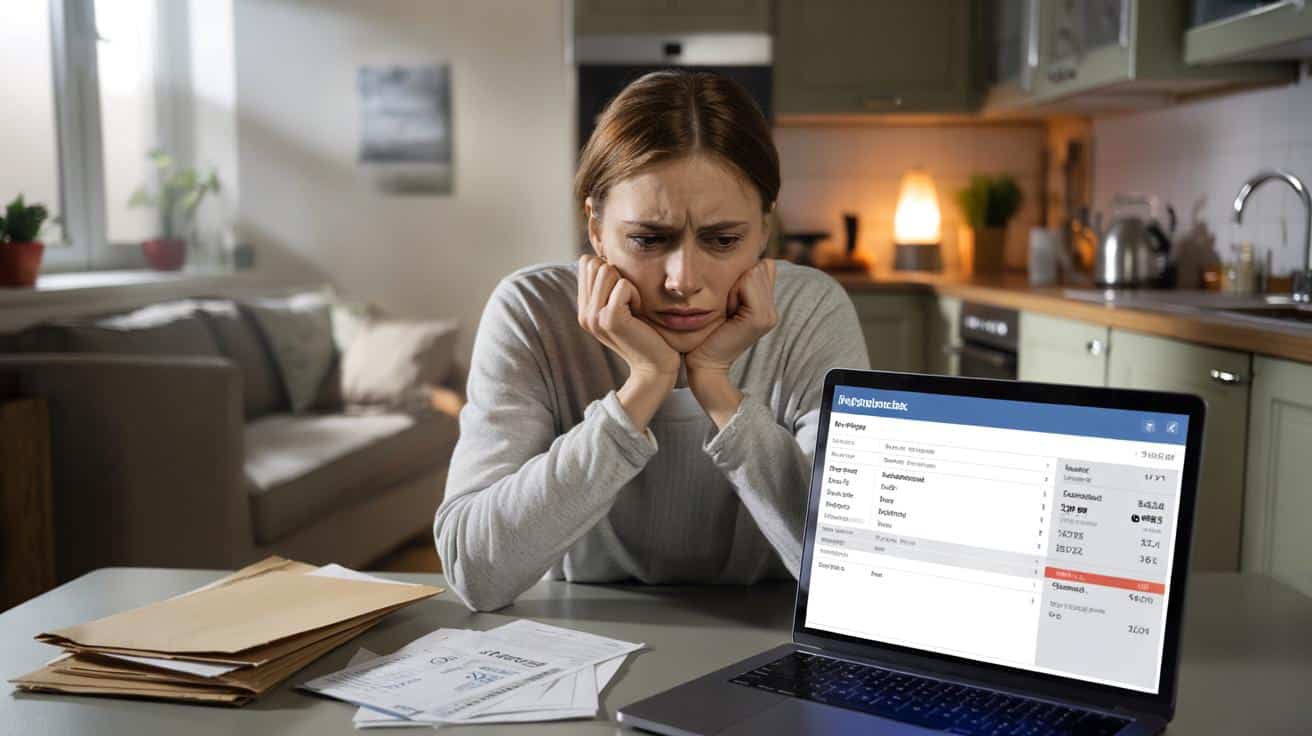
The kettle clicked off, and for a second the apartment was completely quiet. No alarms, no overdue bills, no collection letters on the counter. Just the low hum of the fridge and the soft glow of my laptop screen, already open to my banking app out of sheer habit. I refreshed the balance even though I had checked it that morning. The numbers were… fine. Rent paid. Groceries done. No emergency lurking in the transactions. Yet my chest was as tight as if I’d just opened a final notice.
From the outside, nothing was “wrong”. I wasn’t drowning in debt or facing eviction. Friends said I was “good with money”. But my brain didn’t care about the spreadsheet. Every purchase felt like a small cliff edge.
Something didn’t match between the facts and the feeling.
When money anxiety doesn’t match your reality
There’s a strange kind of financial pressure that doesn’t show up on paper. Your salary covers your life, the numbers pass every budgeting rule, yet your body stays locked in survival mode. You might be sitting in a café you can technically afford, but you’re too busy calculating the bill to enjoy the coffee. The spreadsheet says “you’re safe”, your nervous system says “absolutely not”.
This tension is quiet and sneaky. No drama, no rock-bottom story to share on social media. Just a low-grade hum of guilt, second-guessing, and the sense that you’re one wrong move away from disaster. It feels almost embarrassing to admit when nothing obviously terrible is happening.
A friend of mine, Mia, put it perfectly over a Thursday-night pasta. She earns a stable mid-range salary, zero credit card debt, a small emergency fund. On paper, a solid situation. Yet she confessed that buying a simple 12-dollar lunch made her feel like she was “playing rich” and about to be found out.
Last year, she spent three weeks agonizing over replacing her broken headphones, even though she listens to music every day and had the money. She walked around with half-working earbuds, feeling secretly reckless for even browsing the “nice” models. There was no crisis, just a constant low-level panic that any “unnecessary” expense would flip some invisible switch and send everything crashing.
This mismatch often comes from the stories we grew up with. Maybe you heard adults whispering about overdue bills, or watched a parent check their wallet with that tiny exhale of worry. Even when your current finances are stable, your brain can stay stuck in that old emergency setting.
Sometimes it’s social pressure: scrolling past friends on trips, in new apartments, with upgraded furniture, and quietly deciding you’re behind. At other times it’s perfectionism. If you’re used to chasing gold stars, anything less than “maxed-out savings, perfect investments, no fun spending” feels like failure. Plain truth: financial safety on paper doesn’t magically switch off financial fear in your head.
Shifting from vague panic to clear signals
One small, concrete shift can help: decide what “safe enough” actually looks like in numbers. Not the internet’s version, not your friend’s version, yours. A simple example is picking a personal baseline: three months of essential expenses, or a specific amount you want sitting in your checking account at all times.
➡️ “At 65, I thought I was just aging”: why my doctor said it was actually a routine issue
➡️ People who feel pressure to adapt constantly often suppress emotional feedback
➡️ Psychology shows why emotional regulation is shaped over time, not instinct
➡️ Feeling emotionally “on standby” is a learned psychological response
➡️ This common cleaning habit actually creates more work later
➡️ Why this haircut suits busy lifestyles more than trendy styles
➡️ If you’re over 65, this subtle shift in appetite is more physiological than emotional
➡️ If you feel mentally crowded, psychology explains how emotional load accumulates
Once that baseline is reached, you treat everything above it as “usable” money, not radioactive funds you’re scared to touch. It doesn’t end the anxiety overnight, but it gives your brain a line in the sand. Before that line, tension makes sense. After that line, you train yourself to say, “This discomfort is a feeling, not a fact”.
A common trap is trying to fix emotional pressure with more and more spreadsheets. You tweak your budget, open five different savings pots, color-code your expenses. For a couple of days, it feels soothing, like you’ve finally taken control. Then one unexpected bill pops up, and the tightness in your throat comes roaring back.
The problem isn’t your math. It’s that you’re treating anxiety like a calculation error instead of a nervous system response. That’s why people who double their income often carry the exact same money fear into a bigger paycheck. If the rule in your head is “if I spend, I’m unsafe”, no number will ever feel big enough.
Sometimes financial pressure is just your old fear wearing your current salary as a costume.
- Notice when you feel tense around money even if the numbers are okay.
- Write down what “safe enough” means for you in a single sentence.
- Separate facts (income, bills, savings) from feelings (guilt, fear, shame).
- Allow yourself one small, planned “non-essential” purchase without self-attack.
- Talk about this pressure with one person you trust, without minimizing it.
Learning to spend without the constant guilt soundtrack
One practical method that helps many anxious spenders is the “guilt-free pocket”. The idea is simple: you decide an amount each month that is specifically meant to be spent on non-urgent, non-essential stuff. Coffee dates, a better moisturizer, a book you’ll probably dog-ear and abandon halfway through. You move that amount into a separate account or label it clearly in your budget.
When you spend from that pocket, you practice not apologizing, not compensating, not secretly cutting groceries to “make up for it”. It’s not reckless. It’s a small training ground for telling your nervous system: “We planned this. We are allowed.”
A lot of us sabotage this by setting the guilt-free amount impossibly low, then calling ourselves irresponsible when we inevitably go over it. Or we treat the category as optional, the first thing to slash the minute we feel a flutter of worry. Let’s be honest: nobody really sticks to an ultra-restrictive budget every single day.
Money pressure often softens when you stop chasing perfection and start aiming for consistency. Paying your bills, saving a bit, and leaving some room for life beats six weeks of harsh discipline followed by a stress-fueled shopping spiral. Be gentle with your relapses, but be honest about your patterns.
“I realized I wasn’t afraid of being broke,” one reader told me, “I was afraid of ever feeling broke again. Even when I wasn’t.”
- Try a realistic pleasure budget, not a fantasy number you’d only respect in a crisis.
- Track how you feel before and after “non-essential” purchases, not just how much they cost.
- Replace “I can’t afford this” with “I’m not choosing to prioritize this right now”.
- Notice where your money rules sound exactly like a parent or ex-partner’s voice.
- Keep one tiny ritual that celebrates money going out, not just money coming in.
Living with money as a relationship, not a report card
Once you see that your financial pressure isn’t always about the actual numbers, the whole conversation shifts. You stop asking only “How much do I have?” and start asking “What story am I telling myself when I look at this balance?” The same account can say “You’re behind, you’re late, you’re not doing enough” or it can say “You’re building, slowly, imperfectly, and that counts”.
*You’re allowed to let your financial life be a work in progress, not a verdict.*
Some days, you’ll still refresh your banking app twice in one hour. You might still feel a catch in your breath when you tap your card for something nice. That doesn’t mean you’re failing. It means you’ve lived through a world where money has been used as a threat, a status symbol, a test of worth. Rewriting that script takes time.
Maybe the next step isn’t earning more or cutting back harder. Maybe it’s admitting, out loud, “Nothing is technically wrong, and I still feel under pressure.” You’re not the only one doing that quiet mental math at the café table. And you’re not strange for wanting your money life to feel calmer, not just look “fine” from the outside.
| Key point | Detail | Value for the reader |
|---|---|---|
| Emotional pressure can exist without crisis | Stable finances can still trigger fear based on past experiences and social comparison | Normalizes hidden anxiety and reduces shame |
| Define your personal “safe enough” line | Choose concrete baselines for savings and cash that signal safety to your brain | Turns vague panic into clearer, manageable signals |
| Use planned guilt-free spending | Set a realistic pleasure budget and respect it as part of financial health | Builds a healthier, more sustainable relationship with money |
FAQ:
- Question 1Why do I feel broke even when I’m not?
- Question 2How do I know if my money anxiety is “serious”?
- Question 3Is budgeting making my anxiety worse?
- Question 4What if I grew up with real financial struggle?
- Question 5How can I talk about this with friends or a partner?